How Hines Little Smiles Helps Sensory-Sensitive Kids Feel Comfortable With Dental Care
You made the appointment. You talked it up all week. You even promised a treat afterward. Then a drill starts humming down the hall, the overhead light feels too bright, or someone asks your child to sit in the chair, and suddenly everything falls apart. If you've been there, you're not alone. And more importantly, you haven't done anything wrong.
Some children experience sound, light, touch, smells, and new environments much more intensely than others. A dental office can be overwhelming for a sensory-sensitive child, even when everyone involved is doing their best. What looks like refusal, defiance, or fear is often a nervous system working overtime to process an environment that feels too big, too loud, or too unpredictable.
The good news is that sensory sensitivity doesn't have to stand in the way of good dental care. With the right environment, preparation, and approach, many children who struggle with dental visits can learn to feel comfortable and confident over time.
At Hines Little Smiles, our team builds visits around the child in front of us, adapting the experience to their needs rather than expecting them to adapt to ours.
Continue reading to learn why dental visits can feel overwhelming for sensory-sensitive children and how thoughtful accommodations can help them feel safe, supported, and successful.
Before we get into the how, it helps to sit with the why for a minute. Sensory sensitivity isn't stubbornness, drama, or a child deciding to make your Tuesday harder. It's the nervous system doing exactly what it's built to do, just with the volume turned way up.
For a child with sensory sensitivity, sounds, lights, textures, smells, and tastes don't land the way they do for most people. They land louder, sharper, closer. The hum of a dental tool isn't background noise. The overhead light isn't just bright. The feeling of someone working inside their mouth isn't just unfamiliar; it can be genuinely overwhelming.
A standard dental office wasn't designed with that in mind. That's nobody's fault, but it explains a lot. If your child has ever been told to push through it or accused of being difficult, that framing misses what's actually happening in their body. There's nothing to push through. There's a nervous system that needs to feel safe before it can cooperate. That's the foundation everything else is built on, and it's why the strategies that work aren't tricks or distractions. They're responses to something real.
In practice, a sensory-friendly visit isn't about bending the rules for certain kids. Your child will receive the same high-quality, comprehensive dentistry than usual, the only change is in the way we deliver the service.
For example, lighting can be softened to a warmer tone if your child is triggered by fluorescent light. A few specific supports tend to make the biggest difference. Here are other ways we make the experience comfortable, depending on each patient's needs:
That last one matters more than it sounds. A child who knows they can stop the whole thing is a child who can tolerate so much more, because the fear of being trapped is often bigger than the procedure itself. If your child gets overwhelmed at appointments, our approach to dental treatment for anxiety and special needs is built around exactly these moments.
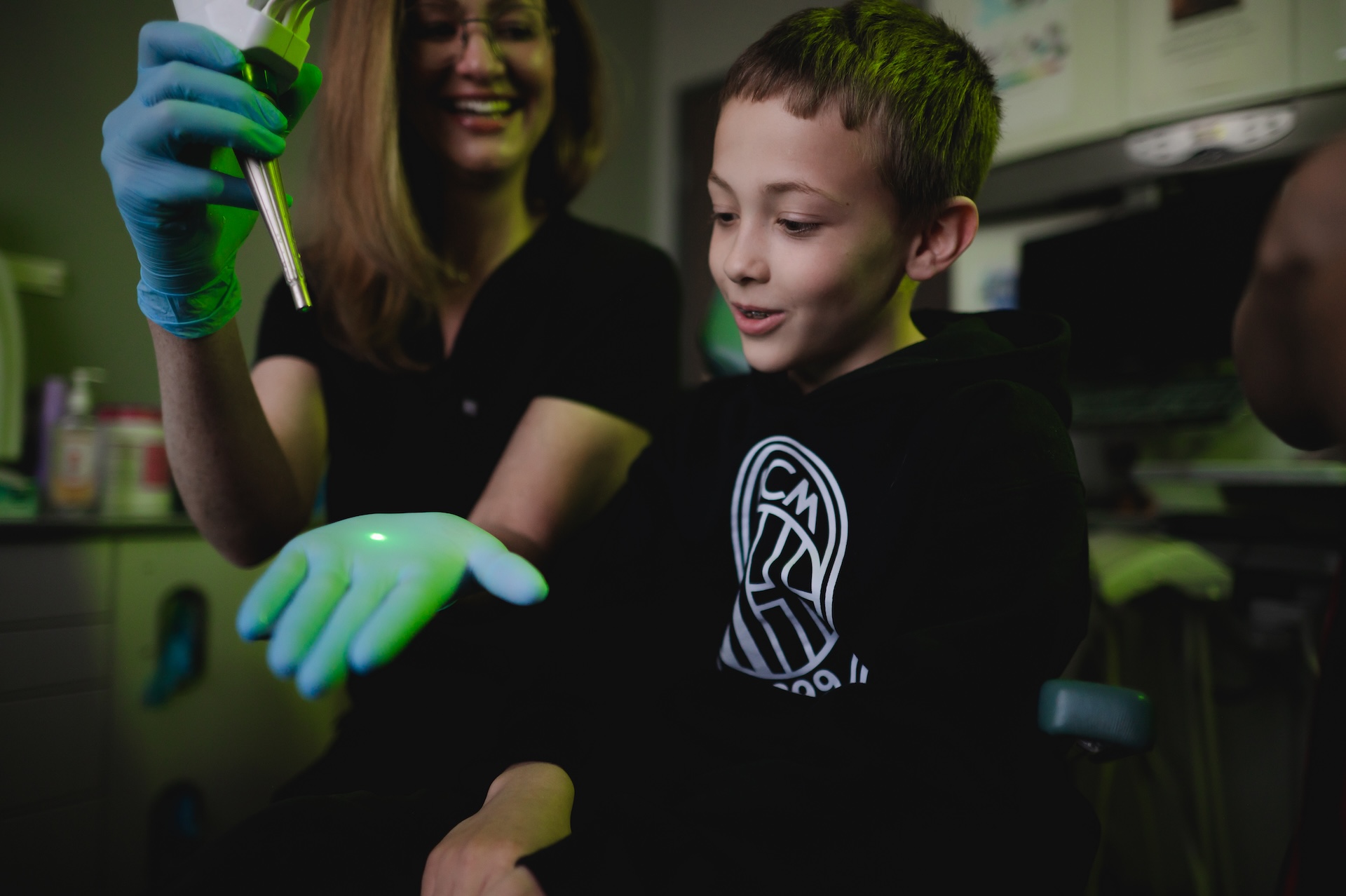
Before any tool comes near your child's mouth, it gets introduced. We show it, explain what it does, and demonstrate it somewhere neutral, like the back of the hand, before it goes anywhere near their teeth. That's the tell-show-do approach, and it turns the unknown into something a child can prepare for instead of brace against. For kids whose sensory needs run deeper, these adaptations sit right alongside our broader comprehensive smile care. None of it is treated as an exception. It's just how we do things.
What happens in our office is only part of the picture. The days leading up to the visit can make just as big a difference, and you have more tools than you might realize.
Social stories and simple visual schedules walk kids through each step of the appointment so it feels familiar instead of surprising. You can find printable versions online or sketch your own. For younger children especially, knowing what comes first, second, and third pulls a lot of the mystery out of the day. Age-appropriate videos help too, since watching another kid go through it calmly and come out fine tells your child more than any reassurance you could give. If your child tends to feel uneasy about new situations, our approach to dental care for anxiety and special needs can help the visit go smoothly.
Try "mouth open" with a flashlight. It sounds silly, but it works. Take turns being the dentist and the patient, use a toothbrush to count teeth, and keep it playful. The goal isn't a rehearsal so much as making the sensations of a dental visit feel ordinary before they ever happen for real.
Neutral, matter-of-fact language tends to land better than big reassurances. "It won't hurt, I promise" can actually backfire, because it signals there was something to worry about in the first place. Something plain like "we're going to the dentist so they can check your teeth and keep them healthy" sets an honest, low-pressure tone your child can hold onto. You're not just dropping your child off and hoping for the best; you're already part of the team.
Being part of the team means speaking up before the appointment starts, not waiting to mention concerns once everyone's already in the room. A quick call or message ahead of time is one of the most helpful things you can do.
Think about what your child actually needs, and pass it along:
Every one of those answers changes how we plan the visit. Telling us your child melts down with your presence isn't a confession; it's useful information, and so is the opposite. We use what you share to actually shape the appointment, not just to nod along. When you call ahead at 614-475-5439, we can do concrete things before your child arrives: dim the lights in the room, have the noise-reducing headphones and weighted blanket ready, set aside extra time so no one feels rushed, and agree on a signal word in advance.
You can find more about getting ready for that first visit on our new patient center.
Some visits are just hard. Even with all the right preparation, a child might cry, refuse to open their mouth, or need to stop before the exam is finished. None of that means anything has gone wrong. It's a normal part of the process, especially early on when everything is still new and a little uncertain.
Comfort at the dentist rarely arrives in one breakthrough moment. More often it grows step by step, visit by visit, as your child learns the space is safe and the people in it are kind. That takes time, and that's completely fine.
A "happy visit" can help here: a low-key appointment with no treatment planned, just a chance to walk through the door, meet us, and get used to the sights and sounds. No pressure, no agenda, maybe a sticker at the end. And if an exam needs to stop early, we'll never make your child feel bad about it. Calling it a day when a child is overwhelmed earns their trust much faster than powering through ever could. Every positive interaction, even a short one, is a deposit toward a kid who actually looks forward to coming back.
Not every child can sit still in a dental chair. Not every child can handle the sounds, the lights, or a stranger's hands near their face without shutting down. That is not a behavior problem, but rather how some kids are wired, and there's nothing wrong with it.
Our team in Columbus work with kids whose sensory needs make dental care genuinely harder for them, and we don't want to make your child be quiet and compliant. We meet our little patients where they are, and we're patient to stay there, adapt to their needs, and reassure them, for as long as it takes.
If you've been putting this appointment off because you're not sure how your child will do, that's okay. A lot of parents feel the same way, and you don't need to have it all figured out before you reach out. Just start the conversation. Call us at (614) 475-5439, or book an appointment online, and we'll take it from there.
Call 614-475-5439 or request an appointment online to set up your first visit. We’ll be in touch soon.
