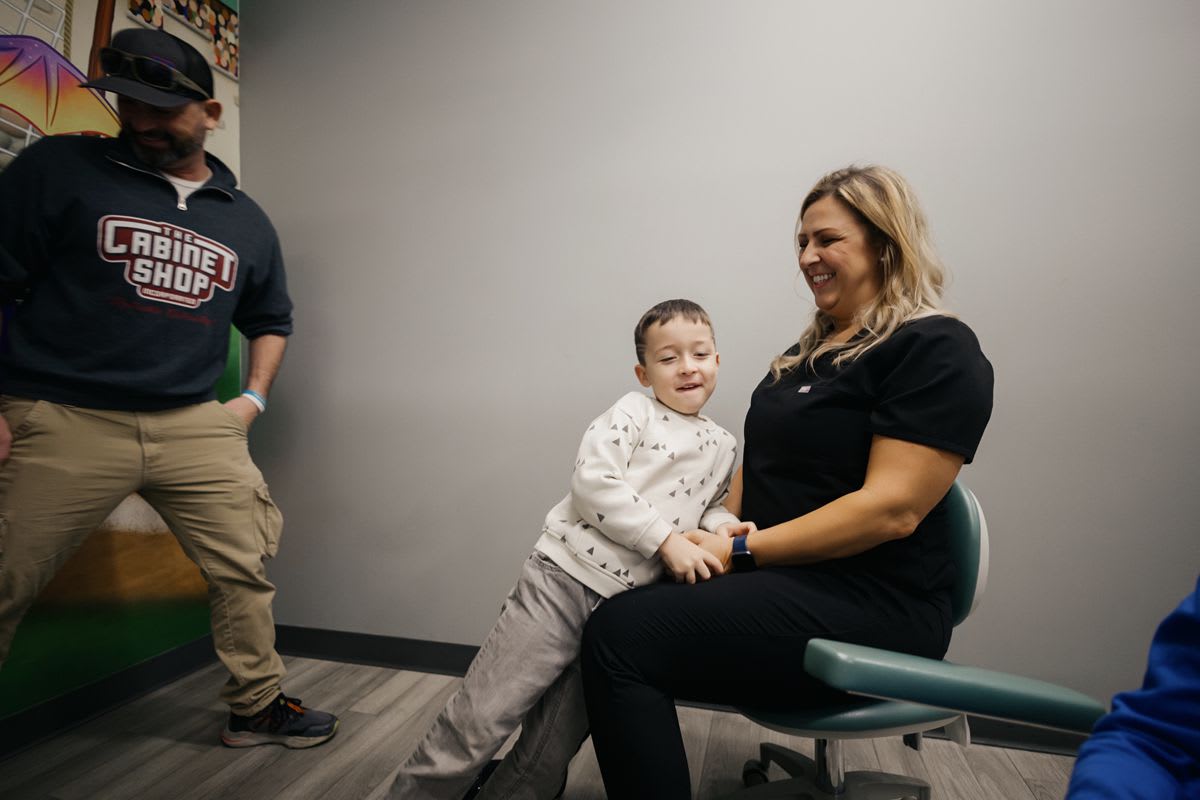
If your child's dentist mentioned a crown and your stomach dropped, you're not alone. Most parents hear that word for the first time mid-appointment, with a wiggly kid in the chair beside them. Let's slow down and go through the whole picture.
A pediatric dental crown is a tooth-shaped cap that fits over a baby tooth too decayed, cracked, or weak for a filling to hold. It protects what's left so your child can chew and smile normally, and it stays in place until that tooth falls out on its own. It's not a sign you did something wrong. It's one repair option among several, used when smaller fixes won't hold up.
Dr. Hines and the team at Hines Little Smiles treat damaged baby teeth every week in Columbus. This guide covers every repair option, from fluoride varnish to crowns to extraction, so you can go into your next appointment knowing the choices.
You can also read about how we approach care differently, or call us at (614) 475-5439 to talk it through.
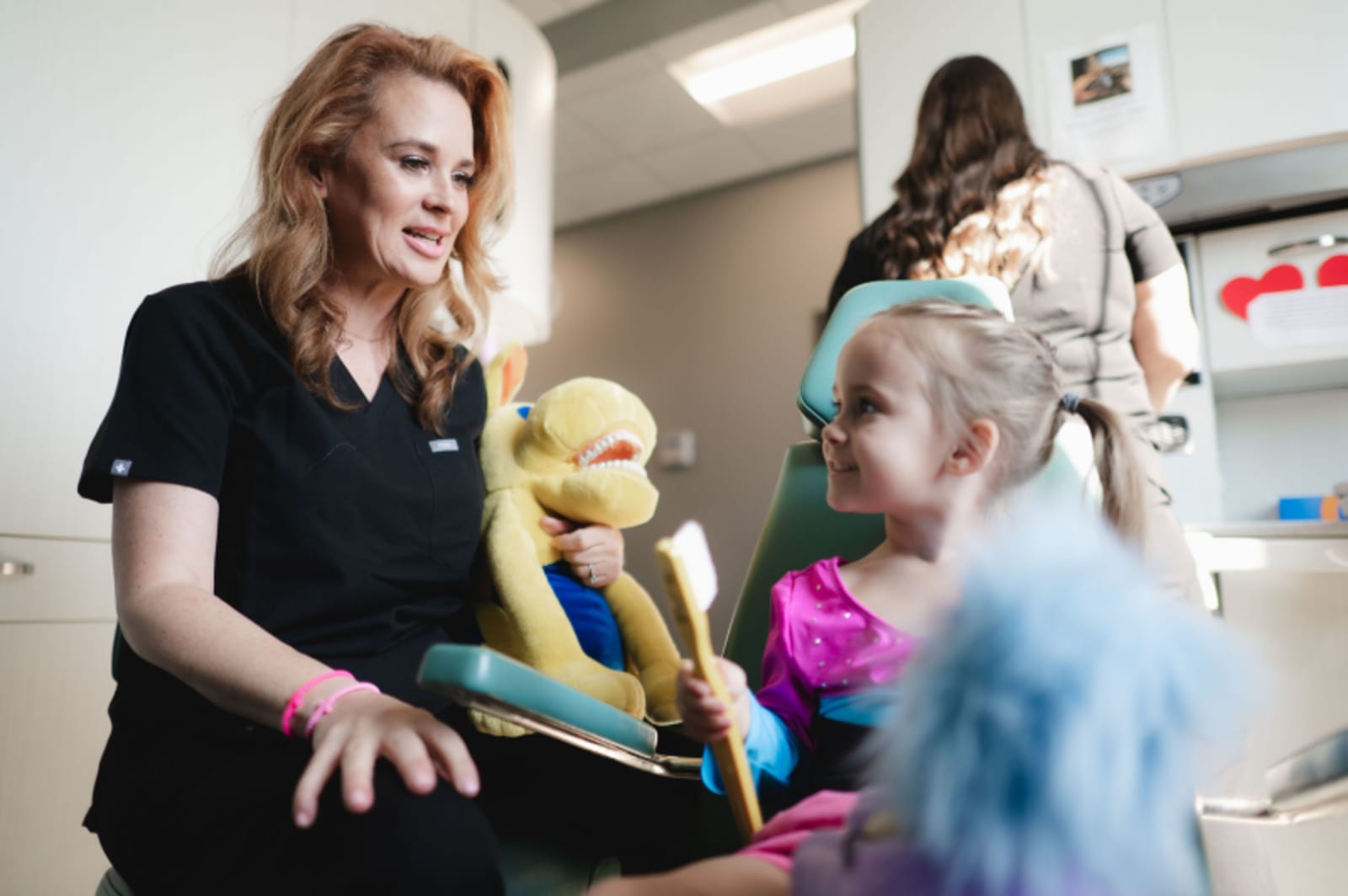
Kids are not great at reporting tooth pain. They'll chew on one side, skip cold foods, and never once say "my tooth hurts." Most of the time, parents notice something is off before the child ever complains.
Pain that comes and goes does not mean the problem is gone. Decay is quiet until it reaches the nerve, and then it is not. Any of these signs is worth a quick visit before it turns into something bigger.
How deep the damage goes changes everything. Two teeth can look almost identical from the outside, but one might have a shallow spot while the other has decay touching the nerve. The treatment for each is completely different.
We check every surface of every tooth, look at the gums and bite, and gently probe anything suspicious. Some early decay is soft and easy to spot. Some has stopped progressing on its own and gone hard and dark. Those two get handled differently. If a tooth is chipped, we also check whether the softer layer underneath the enamel, called dentin, has been exposed. That layer is more sensitive and needs protection.
Cavities often hide between teeth, where a toothbrush and a flashlight can't reach. X-rays show how far decay has traveled, whether the nerve is involved, and how the permanent teeth are developing underneath. Our Columbus office uses digital imaging and Cone Beam 3D scanning, which are quick, low-radiation, and comfortable for kids.
We don't just look at the one tooth. We consider past cavities, diet, brushing habits, fluoride exposure, and family history. Genetics can affect enamel strength and cavity risk, so two kids with the same size cavity may need different approaches depending on what we expect over the next few years.
Very early spots can sometimes be reversed with fluoride and better home care. Moderate cavities with solid tooth structure around them take fillings. Large or multi-surface cavities, cracked teeth, or teeth needing nerve treatment usually need a crown.
A tooth that can't be saved comes out. We always show you the images and explain exactly what we see before anything is decided.
A crown is not the first thing we reach for. There are several smaller treatments to consider first, and the right answer is often one of those.
If decay hasn't broken through the enamel yet, a professional fluoride varnish can help strengthen that spot back up. This only works very early, and home care habits need to improve alongside it.
Sealants are a thin coating painted into the deep grooves of back molars, where most childhood cavities start. Sealing the healthy neighboring molars often matters just as much as treating the one that's already decayed.
When decay has broken through the enamel but plenty of healthy tooth remains, a filling is the standard fix. The decayed portion is removed and the space is rebuilt with tooth-colored material. The limitation is straightforward: a filling needs solid tooth walls to bond to. When a cavity covers several surfaces of a molar, there isn't enough structure to hold a filling reliably, and it tends to crack or leak.
SDF is a liquid brushed onto a cavity that stops decay and kills the bacteria causing it. No drill, no numbing, no needle. That makes it a great option for very young children, kids with anxiety or sensory needs, and teeth that are close to falling out and just need to stay stable a little longer. At Hines Little Smiles, we match the treatment to the child, not a one-size-fits-all checklist.
The trade-off is appearance. SDF permanently stains the treated area black. On a back molar most parents are fine with that; on a front tooth it's hard to miss. It also doesn't rebuild the tooth, so the space is still there and may need a restoration later.
Sometimes a soft filling material is placed to stabilize a tooth when a child isn't ready for full treatment. It buys time until they can handle more, but it isn't a permanent fix.
Every conservative treatment depends on having enough healthy tooth left to work with. Once decay covers multiple surfaces, reaches the nerve, or a tooth fractures, the smaller options stop holding up. That's when a crown becomes the right call.
A crown covers the whole tooth instead of patching one spot. That matters because nothing is left exposed to break or decay again, and the crown handles the chewing pressure so the weakened tooth doesn't have to.
Adult crowns are built to last decades. A pediatric crown has a simpler job: keep that baby tooth intact and comfortable until it falls out on its own.
That's why the materials and approach for kids' teeth look different from adult dental work.
When a tooth is too far gone to save, the alternative is removal with a space maintainer, a small appliance that holds the gap open so nearby teeth don't shift and crowd out the permanent tooth coming in.
A crown keeps that from being necessary. You can browse more parent-friendly explanations in our helpful articles.
The right material depends on which tooth needs the crown, how much of it is still intact, how visible it is when your child smiles, and how your child does in the chair.
These are the most common crown in pediatric dentistry, and the most researched. They come prefabricated in different sizes, get trimmed to fit, and go on in a single visit. They're used almost entirely on back molars, where the pressure from chewing is highest and the silver color is barely noticeable.
The main thing parents ask about is the look. If a back tooth needs full coverage, stainless steel is usually the most reliable choice.
These are tooth-colored ceramic crowns with a natural white appearance. We offer EZ-Pedo zirconia crowns, which work well for front teeth and for parents who want a tooth-colored option on a molar.
Because zirconia is a harder material, the tooth needs more precise shaping before the crown goes on, and your child needs to sit fairly still during placement. They hold their color well and don't stain.
This option uses tooth-colored filling material shaped inside a clear mold over a front tooth, then hardened and the mold removed. The result looks great and it removes the least amount of tooth structure.
The trade-off is that it requires enough healthy tooth remaining to bond to, and it can chip more easily than the other options. It's used for front teeth in specific cases.
Recovery is usually smooth. Knowing what to expect just keeps you from worrying unnecessarily.
Some soreness and sensitivity to hot and cold is normal for the first day or two. Children's pain reliever handles it well. If your child had numbing medicine, watch them for about an hour after the visit. Numb cheeks and lips are easy to accidentally bite, and that tends to hurt more the next day than the dental work itself.
Call if pain is getting worse after day two, if the crown feels loose or comes off, or if the bite feels off once the numbness is gone. Facial swelling, fever, or a bump on the gum near the treated tooth means call the same day. If a crown does come off, keep it and bring it in. The tooth needs to be seen quickly so the space stays open.
Fixing a tooth solves that tooth. It doesn't change what caused the problem. Cavities in young children often lead to more cavities later, so the repair is a good moment to reset the routine.
Brush twice a day with fluoride toothpaste. Use a rice-grain smear for children under three and a pea-sized amount after that. Kids don't have the hand control to brush well until around age seven or eight, so let them go first, then you follow up on the spots they missed, especially the back molars and the gumline. Start flossing as soon as two teeth touch, because that's exactly where the toothbrush can't reach.
A cookie eaten in five minutes is easier on teeth than a juice box sipped over an hour, because every sip restarts an acid attack. Watch for constant snacking, sticky foods, and anything sweet after bedtime brushing. Water between meals is the simplest swap most families can make.
Prolonged bottle use with milk or juice at bedtime is a leading cause of early decay in toddlers. Thumb-sucking and pacifier use past preschool can affect bite development. Mouth breathing and snoring can signal airway issues, and we offer tongue-tie and lip-tie evaluation when that's part of the picture. None of this is about blame. These are patterns that, once spotted, are usually fixable. Our helpful articles go deeper on all of them.
Some topics in this guide have their own dedicated pages with much more detail:
Our helpful articles library covers all of these, and what makes us different explains how we approach care for each family.
Our team includes Dr. Mitzi L. Hines, a Columbus native who completed her pediatric residency at Rainbow Babies and Children's Hospital; Dr. Richa Banthia, trained at Cincinnati Children's; Dr. Michael Hawk, also Rainbow Babies-trained; and Dr. Juliette Leukart.
Every one of us chose to work with kids, so helping a nervous five-year-old feel okay is just as much the job as the dental work itself.
We're at 5770 N. Hamilton Rd., Suite A in Columbus, open Monday through Thursday, 7:30 to 4:30. We'll walk you through what we see, explain our recommendation in plain terms, and answer every question you have.
Whether you noticed something last night or you're still thinking over a crown recommendation, we're happy to talk it through.
Call Hines Little Smiles at (614) 475-5439. We'd love to meet your little one.
Call 614-475-5439 or request an appointment online to set up your first visit. We’ll be in touch soon.