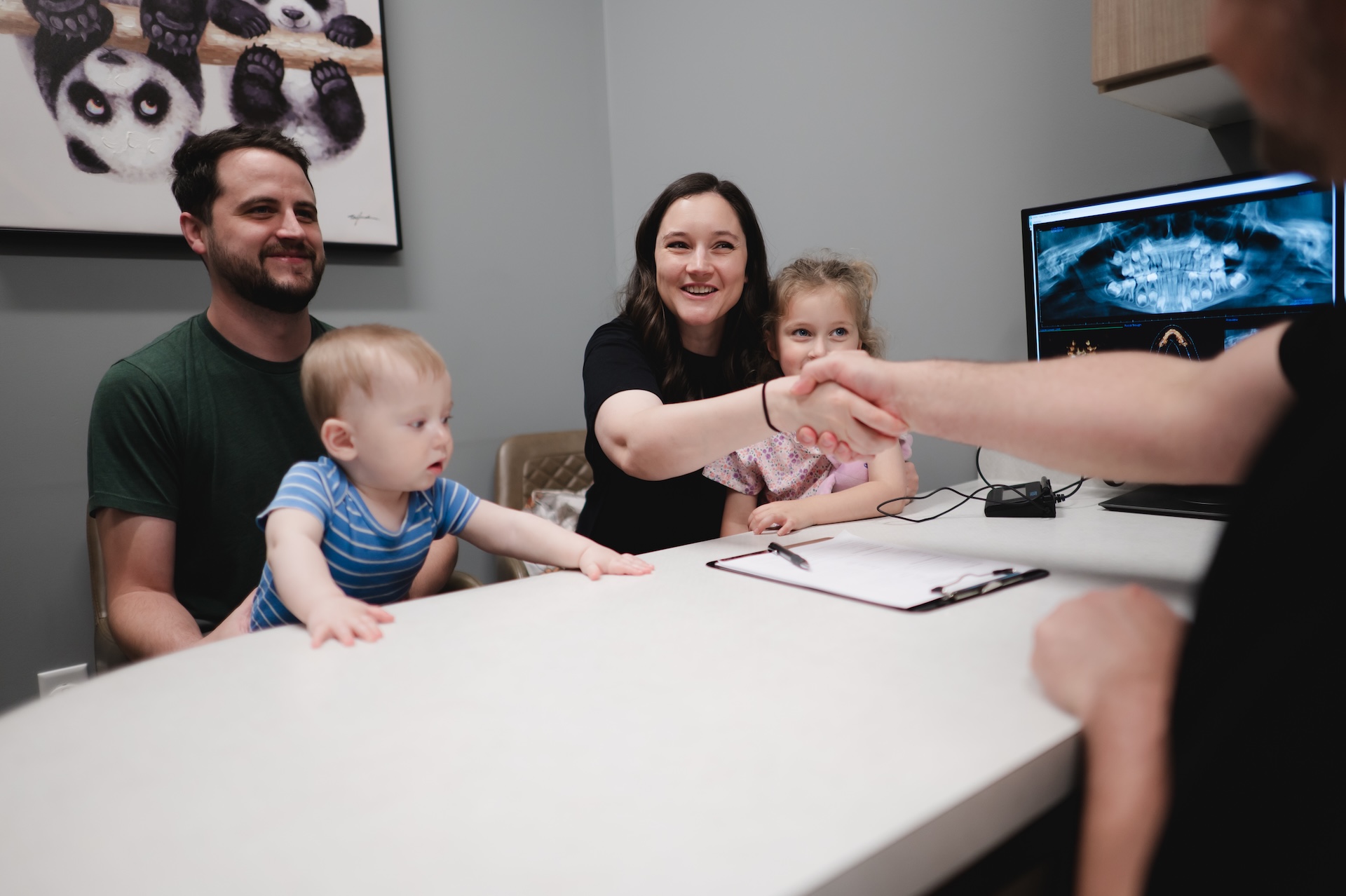
If you've come across the term "fee-for-service" and aren't quite sure what it means for your family, you're not alone. Simply put, fee-for-service practices are not contracted with dental insurance networks. That allows the dentist to focus on recommending care based on your child's individual needs rather than insurance limitations or coverage rules.
At Hines Little Smiles in Columbus, we've chosen this model because it gives us greater flexibility in how we care for children. It allows us to spend more time with families, personalize treatment recommendations, and focus on what's best for each child without network restrictions influencing clinical decisions.
Continue reading to learn how fee-for-service pediatric dentistry works, how insurance and HSA/FSA funds can still be used, what costs to expect, and whether this approach may be the right fit for your family.
Fee-for-service dentistry is a model where families pay the practice directly for the care their child receives, instead of the practice being locked into contracts with insurance companies. There are no network agreements, no carrier-dictated treatment plans, and no coverage rules quietly shaping what gets recommended.
It helps to picture the alternative. In an in-network office, the dentist has signed onto a fee schedule the insurance company sets. That agreement can ripple into all sorts of decisions: which materials get used, how long each appointment runs, even which treatments get suggested first. Fee-for-service removes that layer. The office sets its own fees and reports to the families it serves, not to a payer.
Choosing this kind of practice isn't about settling for less. It's a deliberate decision to put the relationship and the clinical judgment first. Our promise is a simple one: do what's right and keep little smiles happy. That's a much easier promise to keep when nobody outside the room is writing the rules.
To really understand fee-for-service, it helps to see the three main ways dental offices get paid. Most fall into one of three buckets.
These practices contract with one or more insurance companies and agree to discounted, negotiated rates. In exchange, the carrier steers its members toward them. The trade-off is that the plan's coverage rules, annual maximums, and approved-treatment lists become part of nearly every decision.
With a dental HMO, you're typically assigned to a specific office and pay set copays for services. Costs can be low up front, but your choice of provider is narrow, and care often has to flow through the assigned practice.
No insurance contract sits in the middle. The practice sets its own fees, and recommendations come from what the child in the chair needs, not from what a plan classifies as covered. You're free to use any out-of-network benefits you have, but the carrier doesn't get a vote on the treatment plan.
None of these is automatically "right." They're genuinely different philosophies about who the practice answers to. The thing that surprises a lot of families is that fee-for-service doesn't mean tossing your insurance in the trash; more on that further down.
Leaving insurance networks is a big decision, and most practices don't make it lightly. The reasons tend to be clinical and philosophical more than financial.
When a carrier sets the fee schedule, it often sets the pace too. Reimbursement rates can quietly push offices toward shorter visits and higher volume just to stay viable. For a pediatric practice, that pressure runs straight into the reality of treating kids, who need patience, not a stopwatch.
Going out-of-network changes the conversation in the operatory. There's no covered-benefit clock counting down, and no treatment getting swapped for a cheaper option because a plan prefers it. The only question on the table is what a child actually needs.
That's the reason we made the change. We exist to make a real difference in kids' lives, and that's hard to do when appointments are squeezed and care has to fit neatly into a reimbursement code. The independence to slow down, explain things clearly, and build trust with a nervous child was worth more to us than a network logo on the door.
Most parents arrive expecting one upside: fewer claim forms. What catches them off guard is how different the actual visit feels.
The experience simply feels more personal, because there's no invisible third party shaping it. Kids notice the difference. That's the kind of comfortable we're aiming for.
Cost is usually the first thing on a parent's mind. The good news is that openness about pricing is one of the strongest features of this model.
Because there's no carrier deciding things behind the scenes, we can tell you what something costs immediately. No waiting to learn what's covered. No surprise balance arriving three weeks later. No recommendation quietly shaped by what a plan happens to approve. You get a clear picture up front, which makes planning and budgeting far easier.
It's also worth dropping a common assumption: fee-for-service care isn't automatically pricier when you weigh the whole picture. Longer appointments, unrushed visits, and recommendations limited to what your child genuinely needs all carry real value. So does avoiding the slow costs of a rushed diagnosis or a small cavity that grows because care got delayed.
Every family's numbers look a little different depending on what their child needs, so we review costs with you directly before any treatment begins. Exact pricing gets discussed during your visit, along with the payment options below, so there are no guessing games and no pressure.
Yes, and this is probably the biggest misconception we hear. Plenty of parents assume that an out-of-network office means their benefits are off the table entirely. Usually that's not true.
Here's how it generally works: you pay for your child's visit at the time of service, then a claim goes to your insurance company. If your plan includes out-of-network benefits, the insurer reimburses you for a share of the cost, typically based on what they call their "usual and customary" rate. For a lot of families, that reimbursement works out nicely.
The important word is "if." Not every plan includes out-of-network coverage, so it's worth a quick call to the member services number on the back of your insurance card before your visit. Two questions to ask:
One more thing many parents are glad to hear: HSA and FSA funds are generally usable for fee-for-service dental care. If you have a health savings account or flexible spending account, those pre-tax dollars can typically go toward your child's visits. We'll provide whatever documentation you need to submit a claim or back up an account expense.
Still have questions about what works best for your family? That's exactly the kind of honest conversation we love to have. Learn more about what makes our Columbus practice different.
Paying directly doesn't mean it's all on you in one lump sum. Families generally have several routes, and the right one depends on your situation.
Instead of routing through insurance, you pay a flat fee straight to the practice, monthly or annually. In exchange you typically get preventive visits covered and a built-in discount on other treatment. No deductibles, no annual maximums, no waiting periods, no claim forms to chase. What you pay is what you pay. For families with no coverage, or kids who've aged off a parent's plan, this can make consistent care genuinely doable, since cleanings, exams, and X-rays are the foundation of a healthy smile.
Many families use healthcare financing programs that spread the cost of larger treatment into manageable monthly payments. These are arranged through outside lenders rather than the dental office, and approval and terms depend on the program.
As covered above, if your plan has out-of-network benefits, that reimbursement effectively becomes part of your payment picture too.
Because every family's coverage and budget differ, the simplest path is to talk it through with us. We'll lay out what applies to you and what your child needs, then let you decide without anyone hovering over your shoulder.
Walking into a new dental office can feel uncertain, especially if you're used to the in-and-out insurance rhythm. Here's how a first visit with us typically unfolds, start to finish.
When you arrive, the front desk walks you through a straightforward intake and gathers your child's health history. Fees are laid out openly before any treatment starts, so you're never blindsided by a confusing benefits letter weeks later.
Then comes the exam. The dentist takes a good look at your child's teeth, talks you through what they're seeing, and answers any questions you've got along the way. Treatment decisions trace back to one thing: what's best for your child.
A little preparation can help. Some good questions to bring along:
This is where unrushed time stops being a nice perk and becomes the whole point. Anxious children, kids with sensory sensitivities, and children with special needs often need a slower, more flexible approach, and that's exactly what gets squeezed out when appointments are timed to a reimbursement schedule.
When the clock isn't dictating the visit, we can do the things that actually build trust: let a nervous child explore the chair, explain each step in words they understand, pause when they need a breather, and repeat that gentle pattern across visits until the dentist feels familiar instead of scary. Kids who once dreaded coming in start to relax, and some get downright playful. One asked whether he could take a nitrous nose home to wear while playing Xbox, because it would make it "more fun." You can learn more about our approach to anxiety and special needs care and the way we do things differently at Hines Little Smiles.
For families coordinating care for a child with complex needs, that consistency compounds. Knowing your child's history, what soothes them, and what sets them off carries from one appointment to the next, instead of starting over each time. That kind of continuity is hard to put a billing code on, but parents feel it.
Honest answer: it depends, and we'd rather say that than oversell it.
It tends to be a strong fit if you've ever left a dental office feeling like just another name on the schedule, or sensed that a treatment plan was shaped more by what insurance would cover than what your child needed. It's also worth a look if you don't have employer dental coverage, or if your current plan's narrow network keeps steering you toward offices that don't feel right.
On the other hand, if your family has solid in-network coverage and a provider you genuinely like, switching may not add much right now. Budget is real, and we respect that completely.
The families who thrive with this model are the ones who value a steady relationship with their dental team, want care that doesn't feel transactional, and are looking for a practice willing to go above and beyond for their kids. If that sounds like you, you'll likely feel right at home.
Every family deserves a dental home where kids actually want to come back. That's what the whole team at Hines Little Smiles works to create every day: a place where your child feels safe, seen, and genuinely cared for, whether you're booking a first visit, switching from a practice that wasn't the right fit, or asking about our membership plan for families without insurance.
We'd love to meet you. Give us a call at (614) 475-5439 or stop by our office at 5770 N Hamilton Rd, Suite A, Columbus, OH 43230. We love welcoming families from across Columbus and the surrounding area, and whenever you're ready, we'll be here.
Call 614-475-5439 or request an appointment online to set up your first visit. We’ll be in touch soon.